Anyone who has lived through a Melbourne or Canberra winter knows the frustration. The heater runs for hours, the power bill climbs, and yet certain corners of the house remain stubbornly cold. The issue is rarely the thermostat setting. More often, it is a mismatch between the heating system and the architecture it is asked to serve. Actron Air heating mode has built its reputation on solving exactly this problem, and understanding why requires looking past the spec sheet.
The Physics Working Against You
Heat behaves predictably. It rises, it leaks through poorly sealed envelopes, and it migrates toward colder surfaces. In a standard suburban home with two-point-seven-metre ceilings, this is manageable. In contemporary builds with raked ceilings, voids above stairwells, or open-plan kitchens flowing into lounges, the same physics becomes an expensive headache.
Most reverse-cycle units are designed for box-shaped rooms with predictable air movement. When you introduce vertical volume or unusual floor plans, the conditioned air stratifies. Warm air collects near the ceiling while occupants at floor level still feel the chill. The thermostat, usually mounted at head height, reads a misleading average and shuts the compressor down prematurely.
Where Actron’s Design Philosophy Diverges
Actron Air takes a different starting point. Rather than scaling up a small-room product, the brand engineers its larger systems around airflow distribution first and capacity second. This shows up in three concrete ways.
Variable-Speed Inverter Technology
The compressor does not operate as a simple on-off device. It modulates output continuously between roughly thirty and one hundred percent of rated capacity. The practical benefit is that once the room reaches setpoint, the system maintains it with minimal energy draw rather than cycling hard against the thermostat. Over a winter season, this difference compounds into meaningful savings.
High External Static Pressure
For ducted installations, the fan in an Actron indoor unit is built to overcome longer duct runs without losing velocity at the diffuser. This matters because warm air needs momentum to reach the far end of a large room. A weak airflow produces a warm pocket near the supply grille and leaves the rest of the space cold.
Demand-Based Defrost
In outdoor temperatures below seven degrees, all reverse-cycle systems must periodically defrost the outdoor coil. Lower-tier units run defrost on a fixed timer, interrupting heating whether ice has formed or not. Actron uses sensor-driven defrost logic, which means fewer interruptions and steadier indoor temperatures during the coldest hours.
Zoning as the Hidden Lever
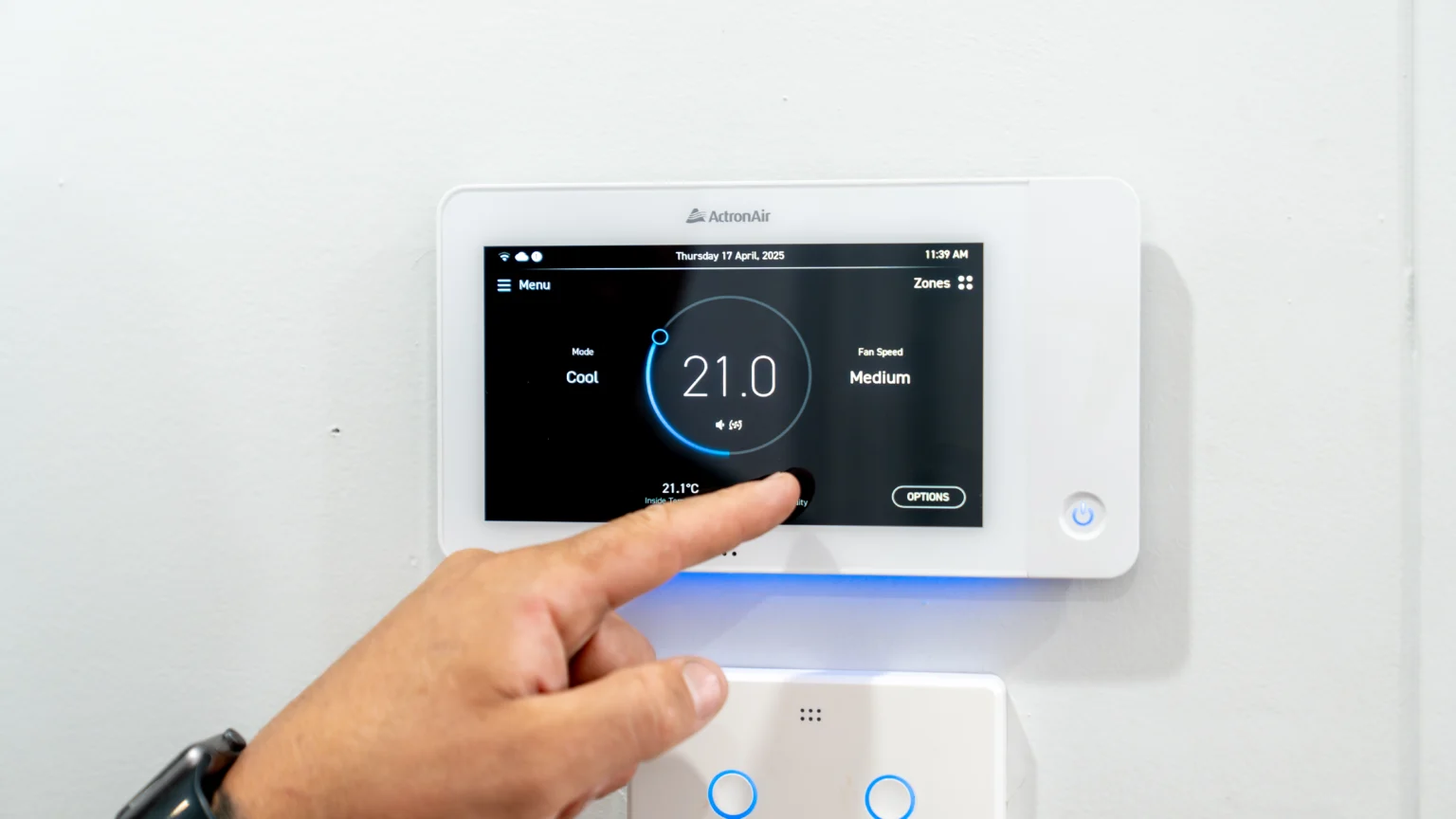
Brandcom, if there is one feature that justifies the price premium for larger homes, it is the zoning capability through Actron’s ICONIC or Que controllers. The system can direct airflow to occupied zones and throttle back unused areas in real time. For a deeper breakdown of how this performs in practice, refer to this article: https://deepchill.com.au/actron-air-heating-mode-the-choice-for-large-rooms/
The implication is significant. A four-bedroom home with a single ducted system effectively behaves like four independent climate zones. You stop paying to heat empty guest rooms while the main living area remains comfortable. Over a ten-year ownership period, this is where the system pays for itself.
What the Brochure Will Not Tell You
A reverse-cycle system is only as good as its installation. Three factors routinely undermine performance, and they have nothing to do with the brand on the front panel.
The first is undersized return-air pathways. If air cannot get back to the unit easily, the fan struggles, efficiency drops, and the room never reaches setpoint. The second is poor outdoor unit placement. Condensers tucked into tight courtyards or shaded alcoves lose heating capacity in cold weather, sometimes dramatically. The third is incorrect refrigerant charge at commissioning, which silently reduces COP for the life of the system.
A reputable installer will perform a heat-load calculation using AIRAH DA09 methodology or equivalent. Ask for it. If the quote arrives without one, the installer is guessing at the size, and guessing tends toward oversizing, which causes short-cycling and humidity problems.
Honest Trade-Offs to Weigh
Actron is not the right answer for every home. For apartments under sixty square metres or single-bedroom heating, the engineering advantages are largely wasted. A mid-tier wall-mounted split from another manufacturer will perform comparably at a lower capital cost.
The case for Actron strengthens when at least two of these conditions apply: ceilings above three metres, open-plan living areas above thirty square metres, multiple zones requiring independent control, or a climate where overnight winter temperatures routinely fall below five degrees. Outside those parameters, you are paying for capability that will sit unused.
Maintenance Habits That Protect Efficiency
Heating performance degrades quickly without basic upkeep. Return-air filters should be cleaned monthly during peak heating months. A clogged filter forces the fan to work harder, reduces heat-exchanger contact, and pushes running costs up by a noticeable margin.
Annual professional servicing should cover refrigerant pressure verification, outdoor coil cleaning, and defrost sensor calibration. The cost of this service is trivial compared to the efficiency loss from running a degraded system through an entire winter. Most owners skip it until something fails, which is the wrong economic decision.
The Practical Takeaway
Choosing Actron Air heating mode is a decision about matching engineering to building physics, not about chasing the highest star rating on the showroom floor. The brand’s advantage lies in airflow distribution, inverter modulation, and intelligent zoning, all of which become relevant precisely when other systems start failing to deliver comfort.
For homeowners with large rooms, high ceilings, or multi-zone requirements, the investment is defensible. For smaller, simpler spaces, the premium is harder to justify. Honest sizing, competent installation, and routine maintenance matter more than the badge on the unit. Get those three things right, and the heating system stops being a topic of conversation, which is exactly the point.
Source: https://deepchill.com.au/actron-air-heating-mode-the-choice-for-large-rooms/