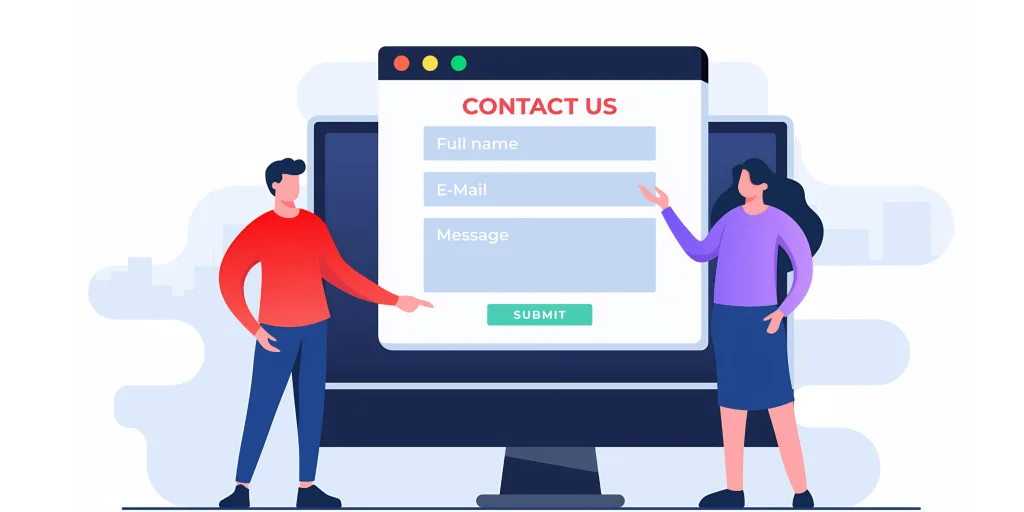
For years, the standard “Contact Us” form has been treated as a harmless default. It sits quietly on websites with a few fields, a generic button, and the assumption that serious buyers will eventually fill it out. Most businesses never question it because the form technically works. Messages arrive. Leads appear. Conversations occasionally happen.
But modern buyer behavior has changed far faster than most websites have.
Today’s visitors arrive with shorter attention spans, higher expectations, and significantly more alternatives. They are comparing vendors in multiple tabs, researching through AI-generated search summaries, browsing on mobile devices, and expecting immediate clarity before committing to any sales interaction. In that environment, the traditional contact form has become less of a conversion tool and more of a friction point.
The deeper issue is not that forms are obsolete. It is that most businesses still design them around internal processes instead of buyer psychology.
That disconnect is costing companies far more revenue than they realize.
A detailed example of this evolving problem can be seen in Brandcom’s analysis here: https://brandcom.au/why-contact-us-forms-dont-convert-and-what-works-better/
The Real Problem Is Not the Form — It’s the Experience Around It
Most underperforming contact pages share the same structural flaw. They ask visitors to commit before the visitor feels confident enough to engage.
That may sound subtle, but it changes everything.
When a user lands on a service page or pricing page, they are often still evaluating risk. They want to understand responsiveness, expertise, pricing expectations, timelines, and credibility. A generic form that immediately asks for personal details interrupts that evaluation process rather than supporting it.
Research across conversion-focused UX studies consistently shows that excessive fields, unclear next steps, and weak mobile experiences dramatically reduce completion rates. Some industry analyses suggest that reducing unnecessary fields can significantly improve submissions, while long or vague forms increase abandonment.
What businesses often interpret as “low-quality traffic” is frequently just unresolved buyer hesitation.
This distinction matters because it reframes the conversion problem. Many websites are not failing due to lack of demand. They are failing because their contact pathways create uncertainty at the exact moment visitors need reassurance.
A user who hesitates for even thirty seconds can easily leave, compare alternatives, and never return.
Why Generic Forms Perform Worse in 2026 Than They Did Five Years Ago
The digital environment surrounding websites has fundamentally shifted.
In earlier years, businesses benefited from larger volumes of informational traffic. Users were willing to browse longer, fill out forms, and wait for responses. Today, the rise of AI-assisted search, instant messaging expectations, and mobile-first browsing has compressed patience dramatically.
Modern buyers expect interaction to feel immediate and contextual.
This is why generic “Name, Email, Message” forms increasingly underperform. They feel disconnected from intent. A visitor looking for a quote, a project estimate, or implementation details does not necessarily want to enter a faceless queue and wait two days for an email response.
Multiple recent analyses highlight that traditional contact forms often convert poorly because they delay clarity and provide no conversational feedback.
The issue becomes even more severe in competitive service industries where response speed directly influences purchasing decisions. A slow or ambiguous follow-up process quietly transfers motivated buyers to faster competitors.
In many cases, businesses spend aggressively on SEO, paid advertising, and content marketing only to lose hard-earned traffic at the final conversion step.
That is not merely a UX issue. It is a revenue leakage problem.
High-Converting Websites Reduce Psychological Friction First
The highest-performing lead-generation websites rarely rely on a single generic contact mechanism anymore.
Instead, they design interaction pathways that reduce uncertainty before requesting commitment.
This can take many forms. Some businesses use conversational landing pages that answer common objections dynamically. Others introduce instant scheduling tools, lightweight qualification prompts, or segmented inquiry flows based on visitor intent. Some integrate live chat strategically, while others replace vague CTAs with highly specific offers tied to user motivation.
The important shift is philosophical rather than technical.
Strong conversion systems acknowledge that not all visitors are equally ready to buy.
A person requesting a detailed enterprise proposal requires a different experience than someone casually exploring options. Yet many websites still force both audiences through the exact same form.
That creates signal confusion for businesses and friction for users.
Several modern CRO studies argue that guided conversational experiences outperform static forms because they align more naturally with buyer momentum.
This does not mean every company needs AI chatbots or complex automation systems. In many cases, relatively small strategic adjustments create meaningful improvements.
Sometimes replacing “Submit” with a more specific CTA significantly changes engagement quality. Sometimes shortening the form matters. Sometimes clarifying response expectations matters more than reducing fields.
The strongest-performing websites obsess over reducing emotional hesitation rather than merely collecting data.
Trust Signals Matter More Than Most Businesses Think
One of the biggest hidden weaknesses in contact pages is the absence of contextual trust.
Many websites move directly from marketing copy into form fields without reinforcing credibility at the moment of decision-making. That is a major mistake because users often experience peak skepticism right before conversion.
Trust is not built through design alone. It is reinforced through specificity.
Clear response timelines, concise proof elements, recognizable client categories, transparent process explanations, and visible human presence all help reduce submission anxiety.
The psychological effect is significant.
When users understand what happens after submission, who will contact them, and why the interaction is worth their time, conversion resistance decreases naturally.
This is particularly important in high-ticket service industries where buyers are evaluating expertise and reliability rather than simply comparing prices.
Businesses often underestimate how emotionally risky contact forms feel from the buyer’s perspective. Every request for information creates a subconscious cost-benefit calculation.
The websites that convert well are usually the ones that answer that calculation before the form is even submitted.
The Future of Conversion Is More Contextual, Not More Aggressive
There is a temptation in digital marketing to solve every conversion problem with louder calls-to-action, more pop-ups, or heavier automation.
That approach often backfires.
The next generation of high-performing lead generation will likely be defined less by aggressive capture tactics and more by contextual relevance. Buyers increasingly expect websites to understand intent, reduce friction, and create momentum naturally.
That means businesses must rethink contact experiences as part of the overall customer journey rather than treating them as isolated website components.
The companies adapting fastest are not necessarily removing forms entirely. They are redesigning the surrounding experience to feel clearer, faster, more trustworthy, and more aligned with user expectations.
That shift sounds simple on paper, but strategically it represents a major evolution in how digital conversion works.
And for businesses still relying on outdated “Contact Us” pages as their primary lead-generation system, the cost of ignoring that evolution is becoming increasingly visible.