Most dental practices assume local SEO is a visibility problem. In reality, it is often a trust problem disguised as a search problem.
A clinic can have experienced dentists, modern equipment, and excellent patient outcomes, yet still struggle to attract new bookings because Google does not reward quality alone. It rewards clarity, consistency, and local authority signals that help patients make fast decisions. That distinction matters more today than it did even two years ago, because local healthcare searches have become increasingly immediate and intent-driven. People searching for a dentist are rarely browsing casually. They are looking for reassurance, proximity, and confidence within minutes.
This shift has changed the role of local SEO for dental clinics. It is no longer simply about ranking for “dentist near me.” It is about becoming the obvious choice when Google compresses dozens of competitors into a handful of visible options. That compression is where most practices either quietly grow or gradually disappear.
The conversation around dental SEO often becomes overly technical, filled with jargon about backlinks, metadata, and algorithm updates. Yet the clinics consistently outperforming their competitors usually understand something much simpler: local search is a reflection of operational credibility. Google is trying to determine which business appears most reliable within a geographic area. The practices that win are the ones that make that reliability easy to verify.
This is why agencies like BRANDCOM have increasingly focused on local positioning strategies specifically designed for dental clinics rather than generic SEO campaigns. Their article on local dental visibility highlights how proximity-based search behavior now drives patient acquisition more than broad digital advertising for many practices. For a deeper breakdown, refer to: https://brandcom.au/local-seo-for-dentists-how-to-get-more-patients-nearby/
The Clinics Winning Local Search Rarely Look “Over-Marketed”
One of the most overlooked realities in dental marketing is that patients do not evaluate clinics the same way marketers do.
Agencies tend to obsess over impressions, click-through rates, and keyword positions. Patients, however, evaluate emotional friction. They ask quieter questions. Does this clinic feel established? Do the reviews sound authentic? Does the website feel current? Are the dentists visible? Is the clinic easy to contact? Does Google seem confident recommending them?
This explains why many highly polished dental websites fail to convert local search traffic into appointments. The site may look impressive from a design perspective, but if the surrounding trust ecosystem is weak, patients hesitate.
Google’s local algorithm increasingly mirrors that human behavior. Reviews, updated business profiles, accurate service categories, localized content, and real clinic photography collectively create a pattern of legitimacy. Individually, these signals appear small. Together, they form a confidence layer that influences both rankings and patient decisions.
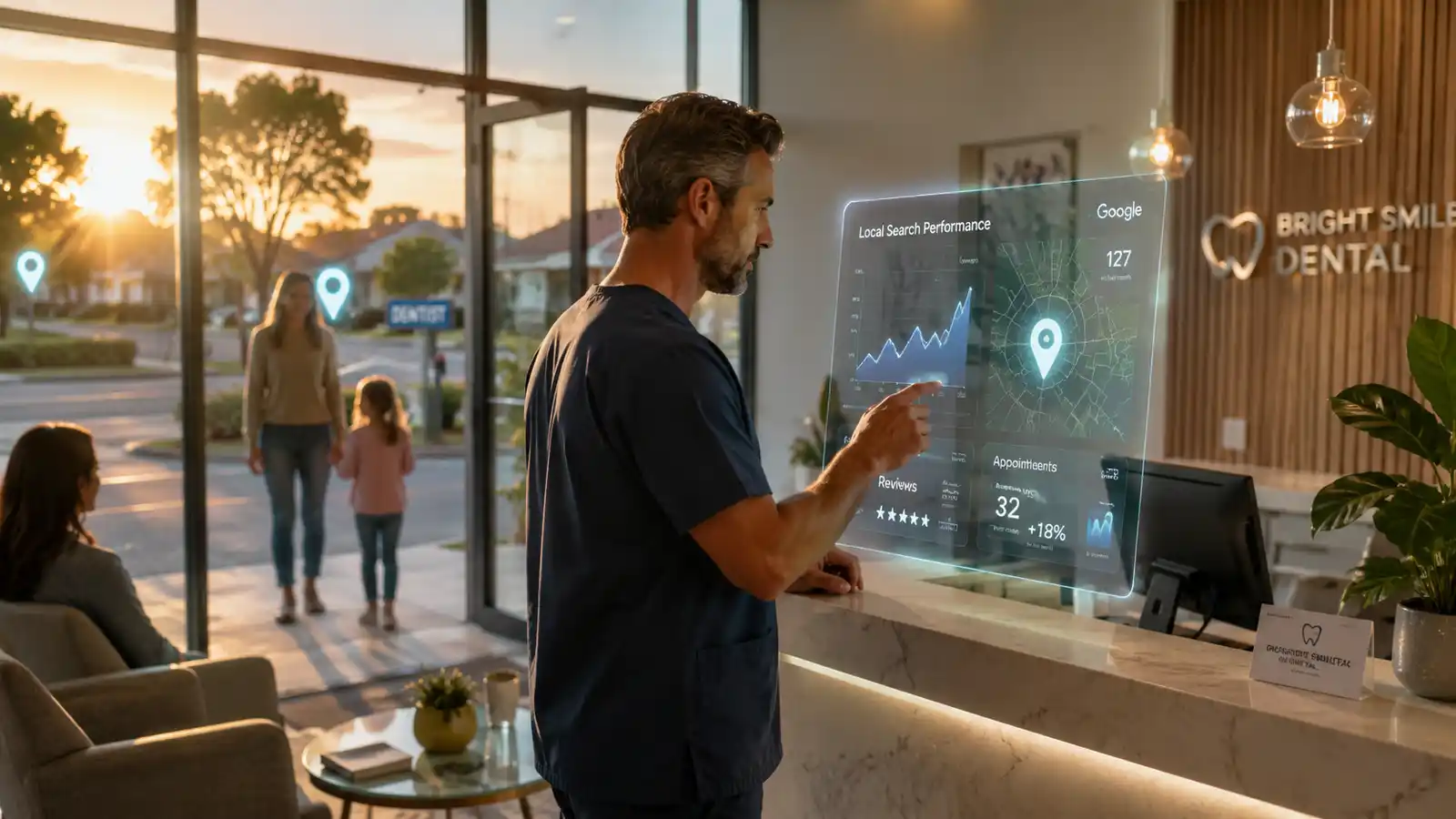
Interestingly, many dentists underestimate how heavily Maps visibility shapes patient acquisition. Several recent industry discussions emphasize that appointment calls frequently originate from Google Maps interactions rather than direct website visits. That changes how clinics should think about marketing investment. The website is no longer the sole digital storefront. The search result itself has become the storefront.
Why “Near Me” Searches Changed Dental Marketing Permanently
The phrase “near me” sounds simple, but it fundamentally altered patient behavior.
Before smartphones dominated local discovery, patients often selected clinics through referrals or broader online research. Today, proximity-based intent compresses decision-making dramatically. Someone experiencing dental discomfort may choose a clinic within minutes of searching. Convenience becomes inseparable from trust.
That urgency creates a major advantage for practices with strong local SEO foundations. Unlike paid advertising, which stops generating leads when spending pauses, local visibility compounds over time. A well-optimized clinic gradually becomes embedded in local search behavior. It accumulates reviews, gains repeated visibility, earns branded searches, and develops geographic authority.
This compounding effect is why local SEO has become strategically different from traditional advertising. Ads interrupt attention. Local SEO aligns with existing intent.
That distinction matters especially in dentistry because dental decisions carry emotional weight. Patients may delay treatment for months due to anxiety, cost concerns, or uncertainty. When they finally search, they want fast reassurance. A clinic with incomplete listings, outdated photos, or inconsistent information introduces hesitation at exactly the wrong moment.
Many practices still underestimate how much operational discipline affects search visibility. Consistently updated business hours, active review responses, current service pages, and locally relevant educational content all reinforce geographic relevance to search engines. What appears to be “SEO work” is often just digital maintenance executed consistently.
The Real Competitive Divide Is Not Budget — It Is Consistency
There is a widespread assumption that larger dental groups dominate local search because they outspend smaller clinics. That is only partially true.
In practice, local SEO frequently rewards consistency more than scale. Smaller clinics with disciplined local optimization often outperform larger competitors with fragmented digital presence. This happens because Google evaluates localized authority rather than corporate size alone.
Community discussions around dental SEO repeatedly point toward the same operational patterns among successful clinics: ongoing review acquisition, suburb-specific service pages, active Google Business Profile management, and localized content strategies. None of these tactics are individually revolutionary. Their power comes from sustained execution over time.
This creates an unusual advantage for independent dental clinics. They are often more agile, more community-connected, and more capable of generating authentic patient engagement than heavily centralized corporate networks. When translated properly into local search signals, that authenticity becomes a competitive asset.
The challenge is that many clinics approach SEO reactively. They invest only after patient flow declines. By that point, competitors may already have years of accumulated local authority. Recovering visibility then becomes significantly more difficult and expensive.
AI Search Is Raising the Stakes Even Further
Another important shift is already underway. Search engines are evolving from directory systems into recommendation systems.
AI-driven search experiences increasingly attempt to identify the “best” local option rather than simply displaying pages ranked by keywords. This transition elevates the importance of entity trust, review sentiment, local authority, and business consistency.
For dentists, this means visibility will depend less on isolated SEO tricks and more on overall digital reputation architecture. Search engines are becoming better at interpreting whether a clinic appears genuinely trusted within its community.
That trend favors practices that invest in long-term credibility rather than short-term ranking tactics. It also explains why reputation management, patient communication, and localized expertise are becoming inseparable from SEO itself.
The clinics likely to dominate local search over the next several years are not necessarily the loudest marketers. They are the ones building durable digital trust signals across every patient touchpoint.
The Future of Dental Growth Is Hyperlocal Authority
The most important realization for modern dental clinics is that local SEO is no longer a marketing accessory. It is operational infrastructure.
When executed properly, it shapes discovery, trust, conversion, and retention simultaneously. It influences whether a clinic appears credible before a patient ever makes contact. It determines whether Google confidently surfaces that clinic during high-intent searches. And increasingly, it affects whether AI-powered recommendation systems consider the practice authoritative enough to suggest.
That is why local SEO has evolved beyond technical optimization. It is now deeply connected to brand perception, patient psychology, and community visibility.
Dental clinics that understand this shift early will likely compound their growth steadily over time. Those that continue treating local SEO as a one-time technical setup may discover that invisibility online becomes increasingly difficult to reverse.