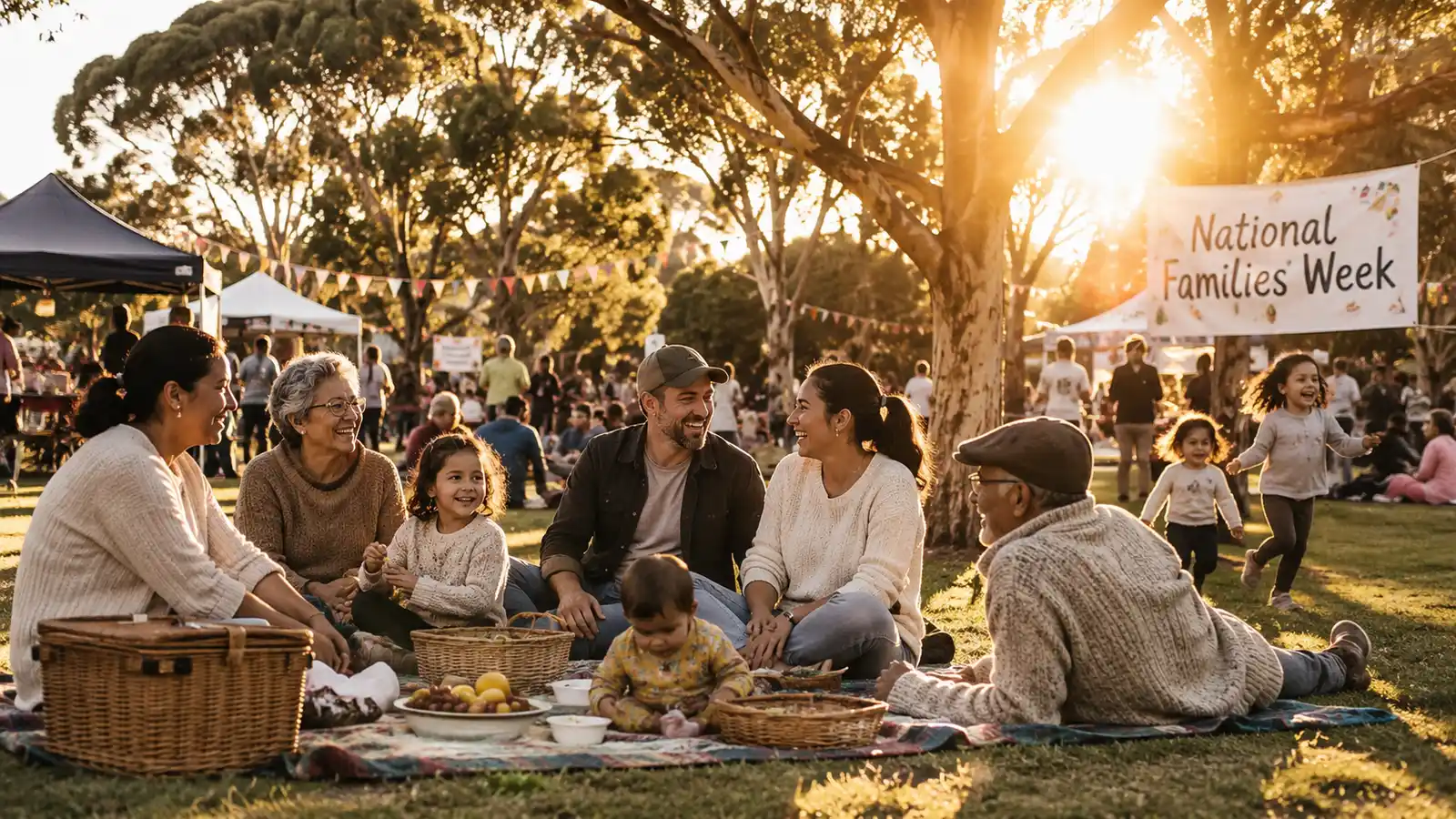
There is something quietly significant about a national event that asks people to slow down and pay attention to their own households. In a culture increasingly shaped by digital overload, fragmented schedules, rising living costs, and constant background stress, National Families Week has evolved into something more meaningful than a symbolic awareness campaign. It has become a reminder that connection itself now requires intention.
Across Australia, National Families Week continues to encourage families to reconnect through shared experiences, community participation, and simple moments of presence. The annual initiative highlights the importance of family relationships in shaping emotional wellbeing, resilience, and social stability. Organizations such as Families Australia and the Australian Department of Social Services consistently frame the week around themes of support, belonging, and community engagement.
What makes the conversation particularly relevant in 2026 is that families are navigating a social environment unlike any previous generation. Technology has made communication constant but attention fragmented. Parents are balancing work flexibility with burnout. Children are growing up inside algorithm-driven entertainment ecosystems that compete directly with real-world interaction. Even when families are physically together, emotional attention is often somewhere else entirely.
That is why the broader idea behind National Families Week deserves deeper reflection. The real challenge is no longer simply finding activities to do together. It is rebuilding shared experiences that feel meaningful enough to cut through distraction.
The article published by MyLotus explores practical ways families can spend time together during the week, focusing on accessible activities and community connection. For a closer look at those ideas, refer to https://mylotus.com.au/what-can-you-do-with-your-family-this-national-families-week/
The Shift From “Quality Time” to Intentional Presence
For years, the phrase “quality time” dominated conversations around parenting and relationships. The assumption was that short bursts of meaningful interaction could compensate for increasingly busy lifestyles. But recent social and behavioral discussions suggest the issue is becoming more complex.
Families are not only struggling with time scarcity. They are struggling with divided attention.
A family dinner interrupted by notifications, passive scrolling during movie nights, or children consuming isolated digital content in separate rooms creates a subtle emotional distance that accumulates over time. This does not necessarily reflect neglect or poor parenting. In many cases, it reflects the structure of modern life itself.
National Families Week resonates because it encourages families to re-establish rituals that create uninterrupted shared attention. These rituals do not need to be elaborate or expensive. In fact, some of the most enduring family experiences are often remarkably simple.
Australian families discussing low-cost activities online frequently highlight experiences such as library visits, nature walks, geocaching, picnics, craft sessions, playground exploration, and cooking together at home. What stands out is not the activity itself, but the consistency of shared participation and conversation surrounding it.
This reflects a larger truth that many families are rediscovering: connection is built less through entertainment and more through participation.
Why Community-Based Family Activities Are Becoming More Important
One of the most valuable aspects of National Families Week is its emphasis on community involvement rather than isolated household experiences. Official events across Australia often include local gatherings, workshops, playgroups, creative programs, and public celebrations designed to encourage social connection beyond the immediate family unit.
This matters because modern family pressure is increasingly tied to isolation.
Many parents are navigating childcare challenges, financial stress, and emotional fatigue without strong local support networks. Families who relocate for work or affordability often lose proximity to extended relatives and long-established social circles. Even suburban communities can become socially fragmented when interaction is limited to school drop-offs and transactional routines.
Community-centered events help rebuild what sociologists often describe as “social infrastructure” — the informal networks that strengthen resilience during difficult periods. A playgroup, shared picnic, volunteer event, or community arts session may appear small on the surface, but these environments create repeated low-pressure interactions that build familiarity and trust over time.
The significance of these spaces becomes even clearer during periods of uncertainty. The Department of Social Services has repeatedly emphasized that social connection and access to supportive environments improve family wellbeing outcomes, particularly for families facing geographic isolation or financial challenges.
In other words, National Families Week is not simply about celebration. It is also about reinforcement. Strong communities strengthen families, and strong families contribute to more stable communities.
The Economic Reality Changing Family Experiences
Another reason the conversation around family activities feels different today is the broader economic climate.
Many households are becoming increasingly selective about how they spend leisure time. Large commercial outings, entertainment venues, and frequent dining experiences are less accessible for some families than they were several years ago. As a result, many parents are returning to lower-cost experiences that prioritize creativity over consumption.
Interestingly, this shift may actually be improving certain forms of family engagement.
Free outdoor activities, neighborhood exploration, public libraries, community festivals, and collaborative hobbies often generate more interaction than heavily commercialized entertainment. Children tend to remember emotional atmosphere and shared attention more vividly than ticket prices or branded experiences.
This is one reason why National Families Week remains surprisingly adaptable. Its core ideas are not dependent on expensive participation. The week encourages families to focus on connection itself rather than performative experiences.
That distinction matters in a culture where social media often pressures parents into presenting idealized versions of family life. Carefully curated family outings can sometimes create more stress than joy. By contrast, meaningful connection is usually quieter, less polished, and more personal.
Family Diversity Is No Longer a Side Conversation
Another important evolution within National Families Week is the growing recognition that there is no single definition of family.
Australian family structures are increasingly diverse, including blended families, single-parent households, multigenerational homes, same-sex parents, foster families, and culturally diverse households. Official National Families Week messaging consistently acknowledges this diversity and emphasizes inclusion rather than traditional family templates.
This broader understanding is socially significant because belonging is strengthened when families feel recognized rather than measured against outdated ideals.
The most effective family experiences are rarely about matching a cultural stereotype. They are about emotional safety, shared identity, mutual support, and consistency. Families function differently depending on culture, economics, geography, personality, and lived experience. Recognizing that diversity allows family-focused initiatives to feel more authentic and accessible.
It also explains why National Families Week continues to remain relevant across changing generations. Its core message is flexible enough to evolve with society while still emphasizing timeless human needs: connection, care, support, and belonging.
The Real Value of National Families Week
The most powerful outcome of National Families Week may not be the events themselves. It may be the interruption.
For one week, families are encouraged to step outside automatic routines and reconsider how they spend attention, energy, and emotional presence. That interruption creates awareness. Awareness creates small behavioral changes. And repeated small changes often shape long-term family culture more effectively than dramatic resolutions.
Families rarely become stronger through isolated grand gestures. They become stronger through repeated moments of listening, shared routines, emotional availability, and consistent participation in each other’s lives.
In that sense, National Families Week serves as something larger than a calendar event. It acts as a cultural reminder that connection requires maintenance, especially in an era designed to fragment attention.
The families who thrive long-term are not necessarily the ones with the most resources or the most elaborate experiences. More often, they are the ones who continue finding ways to remain emotionally present with each other despite the noise surrounding them.
Source: https://mylotus.com.au/what-can-you-do-with-your-family-this-national-families-week/